Network Architecture and Implementation Brief
Executive Summary
This document outlines the finalized network architecture for the Computer Science & Engineering (CSE) Department at Dhaka Polytechnic Institute. Designed to support rigorous academic workloads, the infrastructure leverages a hybrid fiber-copper topology to ensure uncompromising high availability, strict logical segmentation, and scalable throughput. By deploying an Allied Telesis routing and switching core, reinforced by a robust Spanning Tree Protocol (STP) redundancy model, the architecture guarantees resilient connectivity across all five laboratory environments.
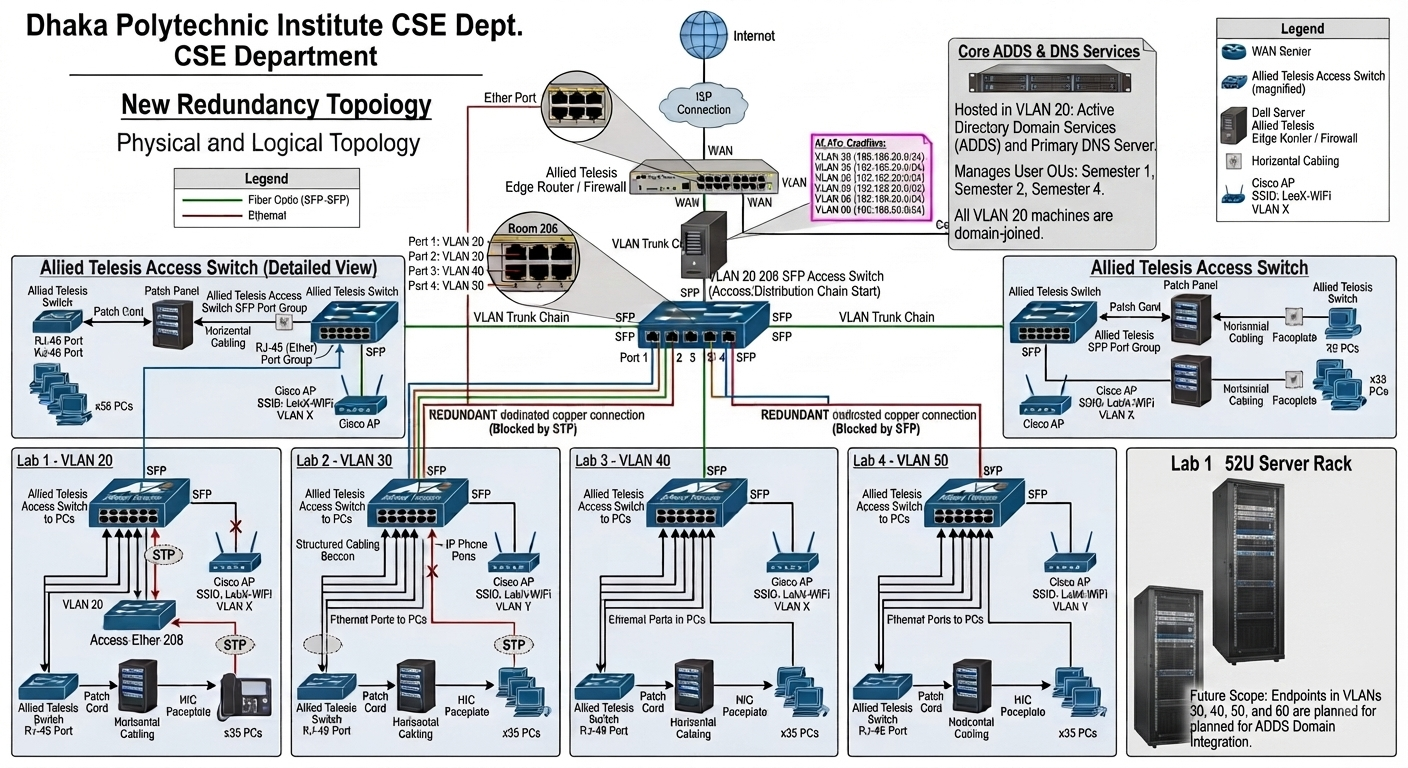
1. Core & Edge Routing Architecture
The perimeter and logical core of the CSE department network are centralized to enforce strict security governance and efficient traffic management.
Gateway and Perimeter Security
The network perimeter is secured and routed by an enterprise-grade Allied Telesis Edge Router/Firewall. This device serves as the primary gateway to the wider campus network and the external ISP. Beyond standard NAT and static routing, the firewall engine actively performs stateful packet inspection, intrusion detection, and access control. By filtering inbound and outbound traffic, it secures the academic environment from external threats while shaping bandwidth to prioritize critical educational services over recreational traffic.
Logical Segmentation (VLAN Integration)
To isolate broadcast domains, enhance security, and prevent localized network events (such as broadcast storms in a single lab) from degrading the entire department's performance, the Edge Router manages five distinct Virtual Local Area Networks (VLANs).
- VLAN 20, 30, 40, 50, and 60: Each VLAN is mapped to a specific laboratory environment. This strict segmentation ensures that student workstations in one lab cannot laterally access resources or intercept traffic from another, enforcing a zero-trust baseline between physical rooms.
Centralized Compute Infrastructure
Directly connected to the core routing layer is a high-performance Dell Server[cite: 1]. This server acts as the localized data center for the CSE department, hosting critical internal services[cite: 1]:
- Web & Database Services: Facilitates local hosting for student projects, SQL/NoSQL databases, and coding environments[cite: 1].
- File Repository: Provides centralized, high-speed storage for large academic files, ISO images, and backups[cite: 1].
- Learning Management System (LMS): By hosting the LMS locally, students can download heavy course materials at wire-speed Gigabit rates without saturating the department's external ISP connection[cite: 1].
- Active Directory Domain Services (ADDS) & DNS: Hosted on the core infrastructure to provide centralized identity management, authentication, and name resolution services[cite: 1].
2. Fiber Backbone & Distribution Layer
To support the heavy data throughput required by modern computer science curricula, the primary distribution matrix relies entirely on a high-speed optical backbone.
The Primary Distribution Node
Room 208 serves as the department's Main Distribution Frame (MDF). It houses the central SFP Aggregation Switch, an Allied Telesis device strictly dedicated to high-speed data transit. This node acts as the optical hub, aggregating all traffic from the downstream labs before passing it to the Edge Router.
Single-Mode Fiber Trunk Chain
The primary data highway between the Aggregation Switch in Room 208 and the individual access switches in Labs 1 through 5 is constructed using Single-Mode Fiber Optics.
- SFP-to-SFP Interconnects: The fiber runs terminate into Small Form-factor Pluggable (SFP) transceivers at both ends. Single-mode fiber is utilized to provide massive bandwidth capacity and absolute immunity to Electromagnetic Interference (EMI), which is critical in a polytechnic environment heavily populated with electrical equipment. This trunk chain ensures near-zero latency for all primary data paths.
3. High-Availability, Redundancy & Spanning Tree Protocol (STP)
The defining engineering achievement of this architecture is its dual-path redundancy. It is specifically designed to survive physical cable cuts or optical transceiver failures without requiring manual administrative intervention.
Dedicated Copper Failover Paths
Operating in parallel to the primary fiber backbone is a redundant copper underlay. The Allied Telesis Edge Router utilizes five dedicated Ethernet ports—each mapped explicitly to one of the five lab VLANs. From these ports, dedicated Cat6 copper Ethernet connections run directly to standard RJ-45 Ethernet ports on the Allied Telesis access switches within each respective lab.
Automated Loop Prevention (STP Convergence)
Running active parallel connections (fiber and copper) between two network nodes inherently creates a Layer 2 routing loop, which would typically result in a catastrophic broadcast storm. To engineer around this, the Spanning Tree Protocol (STP) is actively enforced across the entire switching topology.
- Primary State (Forwarding): STP continuously calculates the "cost" of all network paths. It identifies the high-bandwidth fiber links as the optimal route and places these SFP ports into a continuous Forwarding state.
- Standby State (Blocking): Simultaneously, STP identifies the redundant copper paths. To prevent a loop, STP administratively places these copper ports into a Blocking state. The physical link remains alive, but data transmission is intentionally halted.
- Failover Execution: In the event of a fiber link failure (e.g., a damaged cable or failed SFP module), the switch detects the loss of BPDU (Bridge Protocol Data Unit) signals immediately. STP automatically recalculates the topology, transitions the blocked copper path into a Forwarding state, and restores connectivity to the isolated lab within seconds.
4. Lab Access Layer (Labs 1–5)
The access layer is standardized across all five laboratories, providing a uniform, high-performance, and easily maintainable environment for students and faculty.
Edge Switching Infrastructure
Every laboratory is equipped with a dedicated Allied Telesis Access Switch. These switches receive the high-speed optical feed from Room 208 and distribute network access to the local environment. They are configured with port security features (such as BPDU Guard) to shut down any ports if a student attempts to connect unauthorized networking equipment that could compromise the STP topology.
Structured Cabling and Workstation Delivery
Each lab supports approximately 35 PC workstations. Network delivery to these PCs is achieved through a rigid structured cabling methodology:
- High-quality Cat6 UTP cabling is routed from the Allied Telesis switches into rack-mounted Cat6 Patch Panels.
- From the patch panels, horizontal cabling is run safely through conduits, terminating at wall-mounted or desk-mounted Faceplates.
- This approach ensures Gigabit Ethernet is delivered flawlessly to the desktop while protecting the delicate switch ports from the physical wear-and-tear of a high-traffic student lab.
Wireless Integration
To support modern academic mobility, enterprise-grade Cisco Access Points (APs) are deployed centrally within each lab room, broadcasting a unified SSID (LabX-WiFi).
- Strategic Port Allocation: These Cisco APs are patched directly into the standard copper Ethernet (RJ-45) ports on the Allied Telesis access switches.
- This strategic wiring decision ensures that the switches can deliver both data and Power over Ethernet (PoE) to the APs, while keeping the highly valuable SFP interfaces exclusively reserved for the critical fiber backbone uplinks.
5. Active Directory Domain Services (ADDS) & Directory Integration
To streamline network administration, security policy enforcement, and user credential management, an enterprise-level identity management framework has been integrated into the infrastructure.
Domain Controller and DNS Deployment
The primary Domain Controller and supporting DNS services are successfully implemented and hosted within VLAN 20[cite: 1]. This ensures localized, low-latency name resolution and reliable authentication channels for connected network nodes.
Organizational Unit (OU) Structure
To establish granular access controls, Group Policy Objects (GPOs), and administrative delegation, structured user accounts have been systematically created and organized into four distinct semester OUs[cite: 1].
Workstation Domain Integration and Scalability
As part of the initial rollout phase, all machine endpoints located within **VLAN 20** have been fully joined and integrated into the ADDS domain[cite: 1]. Furthermore, architectural provisions are established to systematically onboard and connect endpoints from **all other department VLANs** to the ADDS domain in future deployment phases[cite: 1].